
Kalaupapa Settlement Genealogy Records
Kalawao County genealogy records document one of the most distinctive communities in American history, preserving the lives of more than 8,000 people who lived at the Kalaupapa leprosy settlement on Molokai's north shore. This guide covers the key archives, online databases, and agencies that hold family history records for the county, from patient registers and burial logs to vital records and census schedules dating back to the 1860s.
Kalawao County at a Glance
Kalawao County Records and Access Overview
Kalawao County sits on the Makanalua Peninsula along the north coast of Molokai. It was carved out of Maui County on April 22, 1903, and it remains the smallest county in the United States by population. The county exists because of the Kalaupapa leprosy settlement, which the Hawaiian government established in 1866 as the only place in the country where people with leprosy were forcibly quarantined. At its peak around 1900, the settlement held 1,177 residents. By the 2010 census, just 90 people remained.
Formal county records in Kalawao begin in 1905. That date covers births, marriages, deaths, court filings, land documents, and probate records. Census records open with the 1910 count. Because Kalawao never developed the full administrative apparatus of a typical county, judicial services have always run through Maui County. The Judicial District of Maui at 200 S. High Street, Kalana O Maui Building, Wailuku, HI 96793, handles court matters. A Kalawao courthouse address is sometimes listed at 74-5044 Ane Keohokalole Highway, Kailua, Hawaii 96740, phone 808-323-4881, though researchers will more often deal with Maui or state-level offices.
The settlement population shrank steadily over the decades. From 785 in 1910, it dropped to 667 by 1920, then 605 in 1930, 446 in 1940, and 340 in 1950. The 1960 count came in at 279, and by 1970 only 172 people remained. Those numbers reflect deaths, discharges, and departures as treatment for Hansen's disease improved. The settlement officially closed in 1969, though the residents who stayed were permitted to live out their lives there. That long decline means genealogists often need to trace families across multiple jurisdictions as members moved on or passed away.
Note: Because Kalawao County has no separate county clerk or local vital records office, researchers must work through the Hawaii State Archives, the Hawaii Department of Health, and the National Park Service to find records tied to this community.
Kalaupapa National Historical Park and Settlement Records
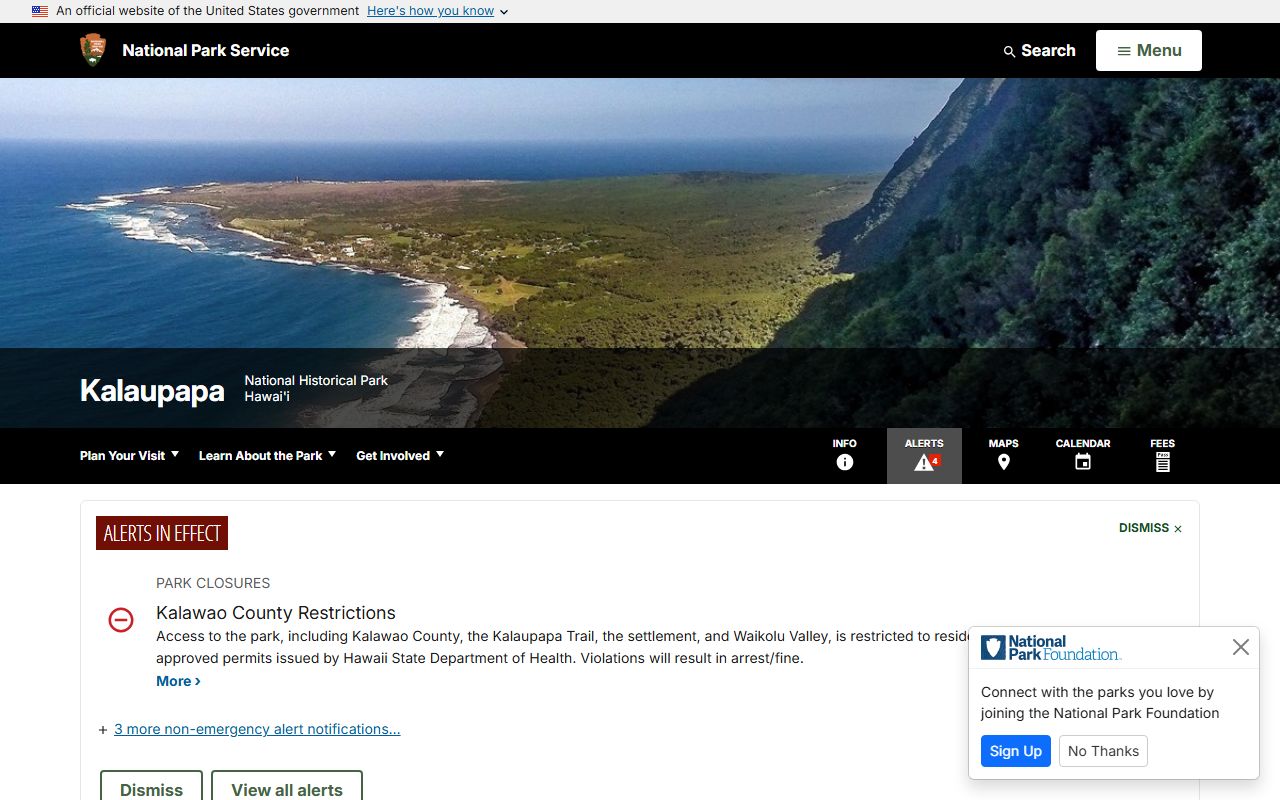
The National Park Service manages Kalaupapa National Historical Park, which preserves the physical landscape of the settlement and can direct researchers toward the appropriate records channels for genealogy inquiries.
The Kalaupapa National Historical Park covers the land where the settlement operated from 1866 until its formal close in 1969. The National Park Service manages the site today. Over the course of those 103 years, more than 8,000 people diagnosed with leprosy, later called Hansen's disease, were sent to Kalaupapa. They came from across Hawaii, from the continental United States, and from other parts of the Pacific. Many arrived as children. Many died there. Their records are scattered across several repositories, which makes Kalawao County one of the more challenging but also one of the more rewarding places to research in Hawaiian genealogy.
The NPS does not serve as a genealogy archive, but the park's staff and historians are familiar with the records landscape and can often point you in the right direction. The park's history and culture pages provide background on the settlement's social structure, religious communities, and administrative history that can help contextualize what you find in the records. Understanding who ran the settlement and when can tell you which office created a given record and where it likely ended up.
The NPS history and culture section for Kalaupapa covers the settlement's administrative history, religious communities, and social life, all of which can help genealogists understand the context behind the records they find.
Hawaii State Archives Kalawao County Collections
The Hawaii State Archives holds the most comprehensive collection of Kalawao County and Kalaupapa Settlement records. These are primary sources created by the settlement's administration, the Board of Health, and local registrars over more than a century of operation. If you have an ancestor who lived at Kalaupapa, the State Archives is the first place to look.
The core collections include the Kalaupapa Death Register of Patients, Kalaupapa Marriage Documents, and the Kalaupapa Patient Register. There is also a Hansen's Disease Records set covering a Kalaupapa Census Index from 1839 to 1970 and a Kalaupapa Vital Records Card Index spanning 1928 to 1947. These records do not cover patients alone. Employees who worked at the settlement, volunteers, priests, nuns, and kokua, the Hawaiian word for helpers who chose to live at Kalaupapa alongside their ill family members, all generated records in this collection. Arrival records, birth records, marriage records, death records, burial records, and census population schedules are all part of the archive.
The Hawaii Digital Archives has made portions of the state collection searchable online. You can browse digitized records without traveling to Honolulu. That said, not everything has been digitized, and a written inquiry or in-person visit may be needed for some records. The Archives address is 364 South King Street, Honolulu, HI 96813. Researchers doing serious Kalawao County genealogy work should plan to contact the Archives directly to ask what is available for a specific time period or person.
Hansen's Disease Records and FamilySearch Collections
The specialized nature of the Kalaupapa Settlement means its records were kept with unusual care. The Board of Health tracked arrivals and departures, monitored the health of each resident, and maintained registers that went well beyond what a typical county vital records office would produce. That institutional thoroughness is good news for genealogists today.
FamilySearch has indexed several major Kalawao-related collections and made them freely available online. The Hawaii Hansen's Disease Records include the Kalaupapa Census Index covering 1839 to 1970 and the Kalaupapa Vital Records Card Index for 1928 to 1947. Beyond those specialized sets, FamilySearch holds statewide Hawaii records that apply to Kalawao County research. Birth records run from 1841 to 1944. Marriage records span 1803 to 1940. Death records cover 1841 to 1925. Divorce records go from 1848 to 1892. Census records are available for 1900 through 1950. The FamilySearch Kalawao County genealogy wiki page explains what is indexed and how to access each collection.
Many patients who arrived at Kalaupapa were young. Some were born there. Birth records from the settlement capture these cases, and the patient register often provides family connections that birth certificates alone would not show. If you know an ancestor was sent to Kalaupapa but cannot find them in standard vital records, the patient register and the census index are the best next steps. Both are available through the State Archives and through FamilySearch.
Church records add another layer. St. Francis of Assisi Catholic Church in Kalaupapa kept records from 1873 to 1978. Catholic missionaries, particularly Father Damien and later the Franciscan Sisters, served the settlement for most of its history, and the church's registers include baptisms, confirmations, marriages, and burials that predate many of the government record series. These church records are a significant resource for anyone researching Catholic families at Kalaupapa.
Note: Some records related to Hansen's disease patients are restricted under privacy protections. The Hawaii Department of Health and the State Archives can advise on what is accessible for a specific research inquiry and what documentation may be required to view restricted records.
Kalaupapa Cemetery and Burial Records
The Kalaupapa Settlement had its own cemeteries, and burial records from those grounds are among the most detailed available for the county. The main cemeteries include the Kalaupapa Settlement cemetery, Kalaupapa Field Cemetery #3, and Kauhako Cemetery. Burial logs often include the date of death, cause of death, and the patient's arrival date at the settlement, giving researchers a tight biographical snapshot in a single record.
Find a Grave's Kalaupapa Settlement cemetery index lists burial records for the settlement, providing a searchable starting point for researchers trying to confirm death dates or locate grave markers for ancestors who died at Kalaupapa.
Find a Grave's Kalaupapa Settlement page indexes burials and allows users to search by name. Volunteers have photographed many of the grave markers, which can show full names, birth years, death years, and in some cases, places of origin. For researchers who cannot visit the remote peninsula in person, Find a Grave provides a practical way to confirm whether an ancestor is buried at Kalaupapa and to gather basic dates.
The State Archives holds the formal burial records that complement what Find a Grave provides. These official records were created by the settlement's administration and often include more detail than a grave marker alone. Cross-referencing the Find a Grave index with the Archives burial records and the death register can give you a complete picture of a person's final years at the settlement.
Hawaii Department of Health and Vital Records Access
The Hawaii Department of Health maintains vital records for the state, including records from Kalawao County. The department's Kalaupapa office historically operated from PO Box 4444, Kalaupapa Settlement, HI 96742. Because the settlement population is now very small, most active record requests are handled through the main Office of Health Status Monitoring in Honolulu. That office issues certified copies of birth, death, and marriage certificates, including those originating from Kalawao County, when an eligible applicant requests them.
Access to Kalawao County vital records follows the same state rules that apply elsewhere in Hawaii. The registrant, immediate family members, legal representatives, and others with a demonstrated direct and tangible interest can request certified copies. Genealogical researchers who do not meet those criteria may have access to records that are old enough to fall outside the restricted window, but current Department of Health staff can tell you what applies to a specific record. Contact the department through the health.hawaii.gov website or by calling their main Honolulu number to start the process.
Some records tied to the history of the settlement carry additional privacy protections because of the sensitive nature of Hansen's disease diagnoses. The department and the State Archives handle these cases on an individual basis. If you are researching an ancestor who was a patient, be prepared to explain your family connection and provide documentation if the records you need fall within the restricted period.
Accessing Kalawao Records Through Maui County
Because Kalawao County never built out a full local court system, the Second Circuit Court of Maui handles judicial matters for the county. The Second Circuit is at 2145 Main Street, Wailuku, HI 96793. Court filings, probate records, and civil case records that originate in Kalawao County may be held there. The Hawaii State Judiciary website has an eCourt Kokua portal where you can search case records by party name across all circuits. That is a practical starting point before calling or visiting the courthouse.
Maui County's connection to Kalawao goes back to the county's founding. Kalawao was carved from Maui in 1903, and the administrative ties have persisted. Researchers working on Kalawao County family history often find that Maui County records provide useful context, especially for family members who lived on the main part of Molokai or moved between Maui and the settlement. Maui County land records and probate files can help fill gaps that Kalawao-specific records leave open. The Maui County Clerk is at 200 S. High Street, Wailuku, HI 96793.
Census records that cover Kalawao County are part of the broader Hawaii enumeration. The 1900 federal census counted 1,177 people in the settlement, a figure that included patients, employees, and kokua. Those census images are available through FamilySearch and Ancestry. They show names, ages, birthplaces, and relationships, which are all standard genealogical data points. For early Kalaupapa research, the census records are often the most complete household-level data available, since they capture everyone present, not just patients.
Note: The Second Circuit Court at Wailuku can help confirm whether a specific probate case or civil matter was filed under Kalawao County jurisdiction and where the records are currently held.
Nearby Hawaii Counties for Related Records
Family history tied to Kalawao County often extends into neighboring counties. Many Kalaupapa patients had family on other islands, and their vital records, land titles, or probate filings may be held in those counties rather than in Kalawao itself. The four other Hawaii counties each hold records that can complement a Kalawao County genealogy search.
- Maui County - handles judicial matters for Kalawao and holds Second Circuit Court records including probate and civil filings
- Honolulu County - home to the Hawaii State Archives and main Department of Health office, both of which hold Kalawao records
- Hawaii County - Big Island records from the Third and Fourth Circuit Courts, relevant for families who moved between islands
- Kauai County - Fifth Circuit Court records for families with Kauai connections prior to or after the Kalaupapa years
The Hawaii State Archives in Honolulu serves all counties and is the single most important repository for Kalawao County genealogy. Any serious research into Kalaupapa Settlement records will eventually lead there. The Archives holds records transferred from settlement administration, the Board of Health, circuit courts, and other agencies across more than a century of Kalawao County history. Starting with the Archives and then branching into Maui County court records and the FamilySearch collections gives you the broadest coverage with the least duplication of effort.