Search Honolulu County Genealogy Records
Honolulu County holds some of the most complete genealogy records in Hawaii, covering birth, death, marriage, probate, land, and court filings that stretch back to the mid-1800s. Researchers tracing family lines through Oahu will find records spread across the State Archives, the First Circuit Court, the Bureau of Conveyances, and several library collections, many of which are now accessible online.
Search Public Records
Sponsored Results
Honolulu County Quick Facts
1M+
Population
Honolulu
County Seat
First Circuit
Circuit Court
1852
Records From
Honolulu County Records Offices
Vital records for Honolulu County are handled at the state level through the Hawaii Department of Health, not through a county clerk. The DOH office on Oahu is on Punchbowl Street in Honolulu and processes requests for certified copies of birth, death, and marriage certificates. Walk-in service runs Monday through Friday, 7:45 a.m. to 2:30 p.m. You can also order records online through the state's eHawaii vital records portal. The first certified copy costs $10. Each extra copy is $4. There is a $2.50 online convenience fee per order.
The City and County of Honolulu also maintains its own Municipal Reference and Records Center at City Hall Annex. That office holds city legislative records going back to 1905, financial records, historic engineering maps from the 19th century, and photographs of public works. Hours are Monday through Friday, 9 a.m. to 3 p.m., with a lunch closure from 11:45 a.m. to 12:30 p.m. Archival visits require an appointment. This office is useful for anyone researching ancestors who lived in Honolulu during the late 1800s or early 1900s.
| DOH Vital Records |
1250 Punchbowl Street, Room 103, Honolulu, HI 96813 |
| Phone |
(808) 586-4539 |
| Hours |
Monday–Friday, 7:45 a.m. to 2:30 p.m. |
| Online Orders |
vitrec.ehawaii.gov |
| Municipal Records Center |
City Hall Annex, Honolulu, HI 96813 |
| Municipal Phone |
(808) 523-4044 |
| Bureau of Conveyances |
1151 Punchbowl St #120, Honolulu, HI 96813 |
| Bureau Phone |
(808) 587-0147 |
Under Hawaii Revised Statutes HRS §338-18, access to vital records within the past 55 years is limited to individuals with a direct or tangible interest in the record. Records older than 55 years are open to the public. For genealogy purposes, records 75 years or older carry no access restrictions at all. This means researchers working on family lines from the early 1900s or before can generally access records without needing to prove a relationship.
Honolulu First Circuit Court Records
The First Circuit Court serves Honolulu County and the island of Oahu. Its eCourt Kokua system gives the public free online access to civil and criminal cases, Land Court filings, Tax Appeal Court cases, Family Court criminal records, and traffic cases. You can search by party name, case ID, or vehicle information. Case IDs use a 12-character format. A case number like 12345 becomes 1PC000012345, where the first digit identifies the First Circuit.
The First Circuit Court's eCourt Kokua search portal provides access to Honolulu County court filings dating back to the mid-1990s in most case types.
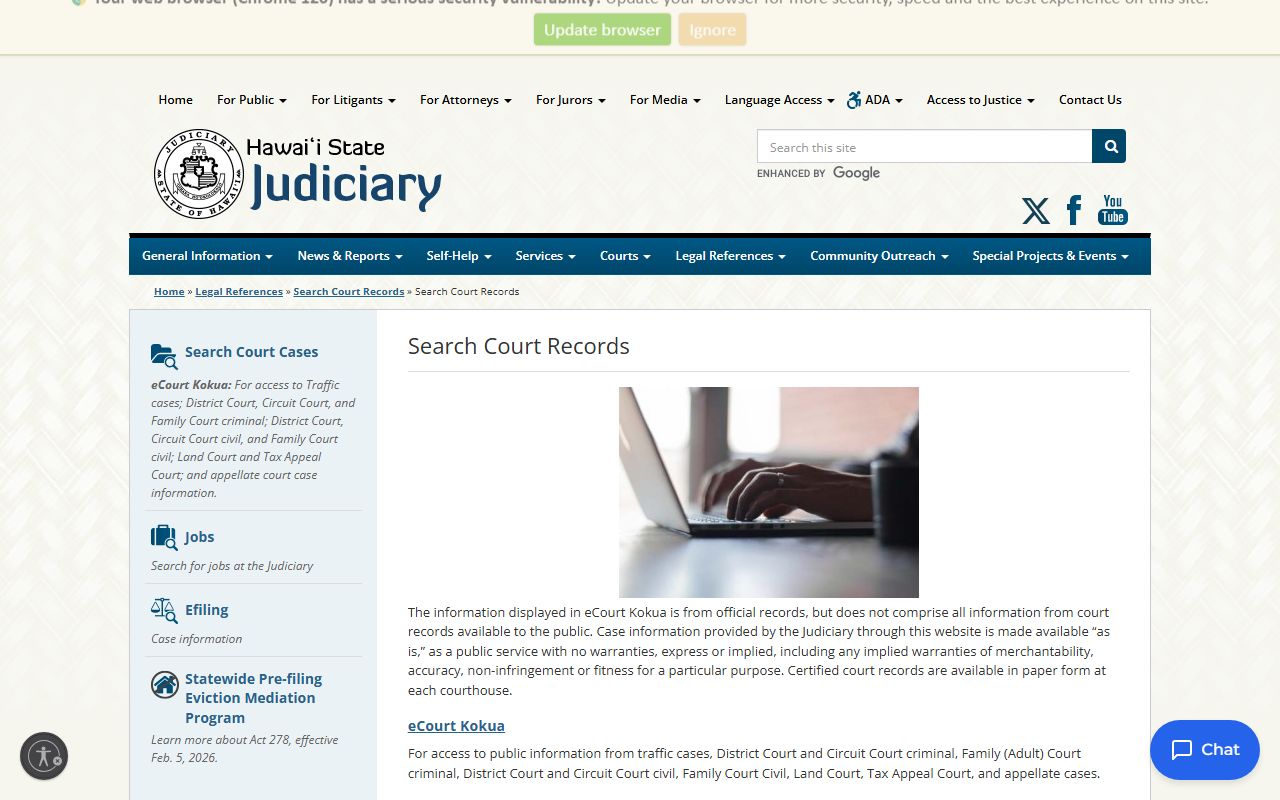
eCourt Kokua also links to the Ho'ohiki system, which covers criminal and civil case files in Circuit and Family Courts, including case titles, party lists, document inventories, and court minutes; the system updates nightly and stays current within 48 hours.
Document copies cost $3.00 each for regular copies and $5.00 for certified copies. If you need many records, a quarterly subscription runs $125 and an annual subscription is $500, both allowing unlimited single downloads. Downloadable documents are also available at $3.00 each or 10 cents per page, whichever is greater. Keep in mind that traffic cases before November 1995, District Court criminal cases before August 2012, and appellate cases before September 2010 are not in the online system. For those older records, contact the Kapolei Judiciary Complex, which serves as the primary location for First Circuit Court record retrieval.
Historical court records from 1839 to 1970 are at the Hawaii State Archives. These include civil, criminal, marriage, divorce, equity, law, probate, and will records from the Hawaiian Kingdom era. The First Circuit Probate case files from the Hawaiian Kingdom period have been digitized and can be accessed through Hawaii's Digital Archives.
Note: The Kapolei Judiciary Complex is the primary contact point for in-person First Circuit Court record requests on Oahu.
Honolulu County Probate Records
Probate records are among the richest genealogy sources in Honolulu County. The Hawaii State Archives holds probate and will records spanning from 1847 to 1917. The LDS Church filmed many of these records selectively around 1970, so some are available through FamilySearch as well. A typical probate case file contains an inventory of property, petitions for account allowance, executor or administrator accounts, and the final settlement inventory. These files name surviving family members, heirs, guardians, and financial successors, making them especially useful for tracing family structure across generations.
The Hawaii State Archives probate research guide details how to search Oahu First Circuit probate records.
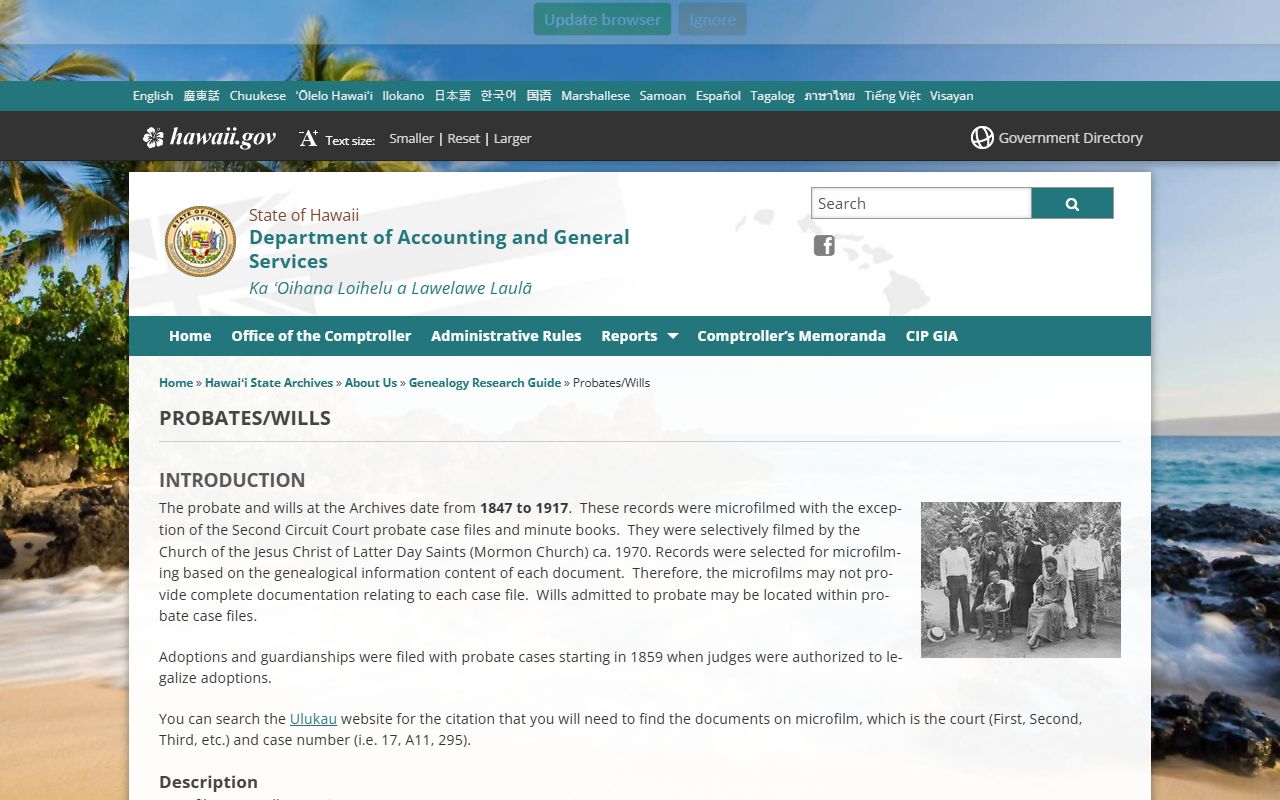
The Oahu First Circuit probate collection covers 1847 to 1921, with 83 digitized entries under reference number 007, and the wills collection covers 1893 to 1916.
One thing to keep in mind: probate cases were often filed years after the person died. The filing date in the index does not always match the death date. Always check the case file itself for the actual death date and place. Many documents appear in both Hawaiian and English. The State Archives has translated some of the Hawaiian-language records, but not all. Adoptions and guardianships were also filed with probate starting in 1859, when judges were first authorized to legalize adoptions. If you are looking for adoption records from the late 1800s, start with probate filings. To access a specific file, search Ulukau for the citation, note the circuit and case number, then use the Digital Archives Judiciary page to retrieve it.
Honolulu Marriage Records Search
Marriage records for Honolulu County go back to 1826. The State Archives holds the main collection, which spans 1826 to 1929 and is indexed from 1826 through 1910. For online research, the Hawaii State Archives Digital Collections site is the best starting point for pre-1930 records. FamilySearch also carries Hawaii marriages from 1826 to 1922 at no cost.
The digital archives site hosts indexed Honolulu marriage records that let you search by name across several decades of historical collections.
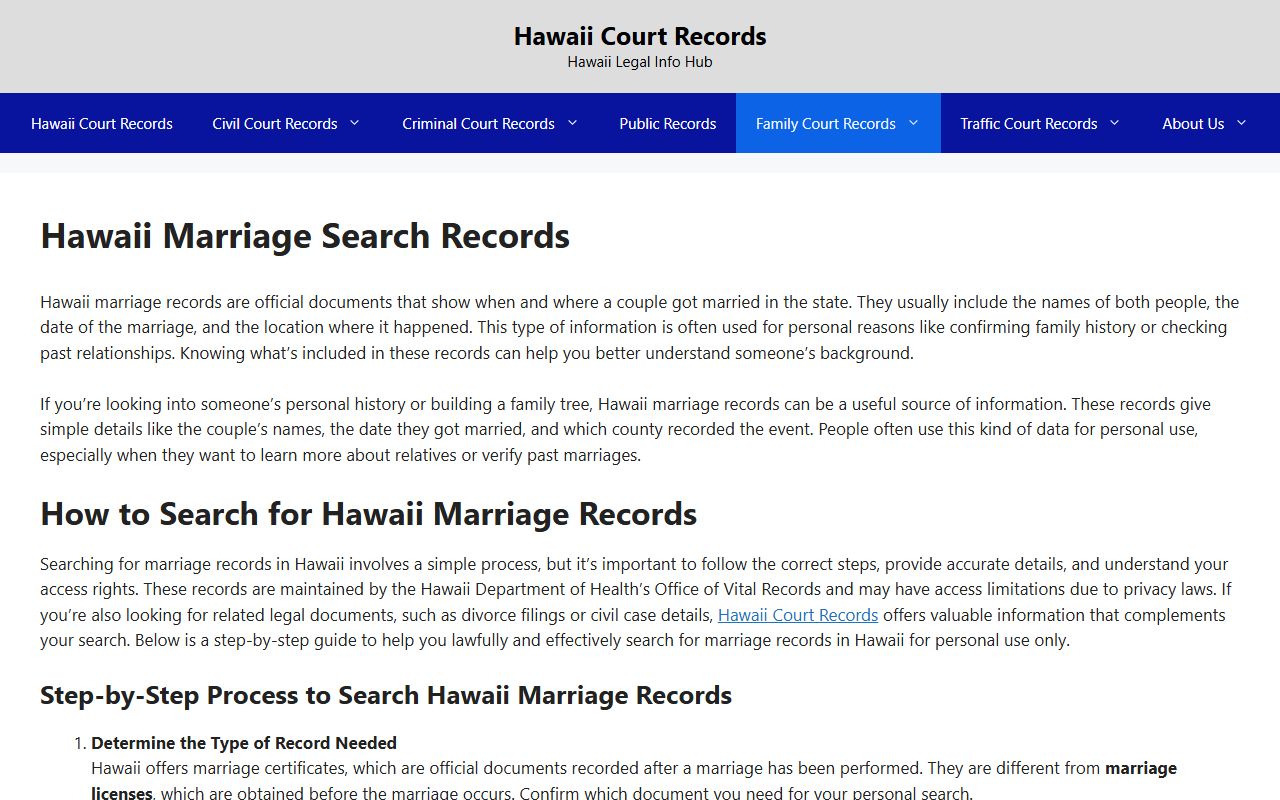
Marriage certificates on microfilm for the Oahu First Circuit from 1900 to 1949 are arranged alphabetically by the groom's name, so knowing the groom's surname makes searching much faster.
For recent records, the DOH handles certified copy requests. If the marriage occurred within the past 55 years, access is restricted to direct family members and others with a tangible legal interest. You will need to provide the full names of both people, the approximate date and place of marriage, your relationship to them, a government-issued photo ID, and $10 per certified copy. Civil union records for same-sex partnerships are also on file and follow the same access rules. Older records, particularly those from the Hawaiian Kingdom era, are largely available to any researcher without restriction.
Land Records and Naturalization
The Bureau of Conveyances at 1151 Punchbowl Street maintains land records for Honolulu County. Grantor and Grantee indexes go back to 1845. Many early documents are written in Hawaiian, which can slow research but also reflects the unique history of property transfer on Oahu. Kuleana land records are particularly important for genealogists with Native Hawaiian ancestry. Land Court was established in 1903 through Act 56 using a Torrens-based registration system. Researchers can call the Bureau's main line at (808) 587-0147 or the direct line at (808) 586-0380 for help locating specific deeds or parcel histories.
Naturalization records for Hawaii span 1838 to 1991. The Kingdom period covers 1844 to 1894 for naturalizations and 1846 to 1898 for denizations. Passport records run from 1845 to 1874. These records often list the person's name, country of origin, current place of residence, date of naturalization, age, occupation, and family members. For researchers with immigrant ancestors who came through Honolulu, the Index to Filipino Passengers Arriving at Honolulu covers 1900 to 1952. Passenger lists of aircraft departing Honolulu cover 1942 to 1948, useful for wartime-era research. Hawaii Voter Records from 1864 to 1910 and Honolulu Voter Registration Applications from around 1920 to 1966 are also available and can help pin down residency dates and family household information.
The Hawaii State Archives genealogy research portal at ags.hawaii.gov provides guides to accessing all of these record groups, with detailed finding aids for each collection.
The Hawaii genealogy collections at the State Archives are extensive and cover multiple record types that are valuable for Oahu family research.
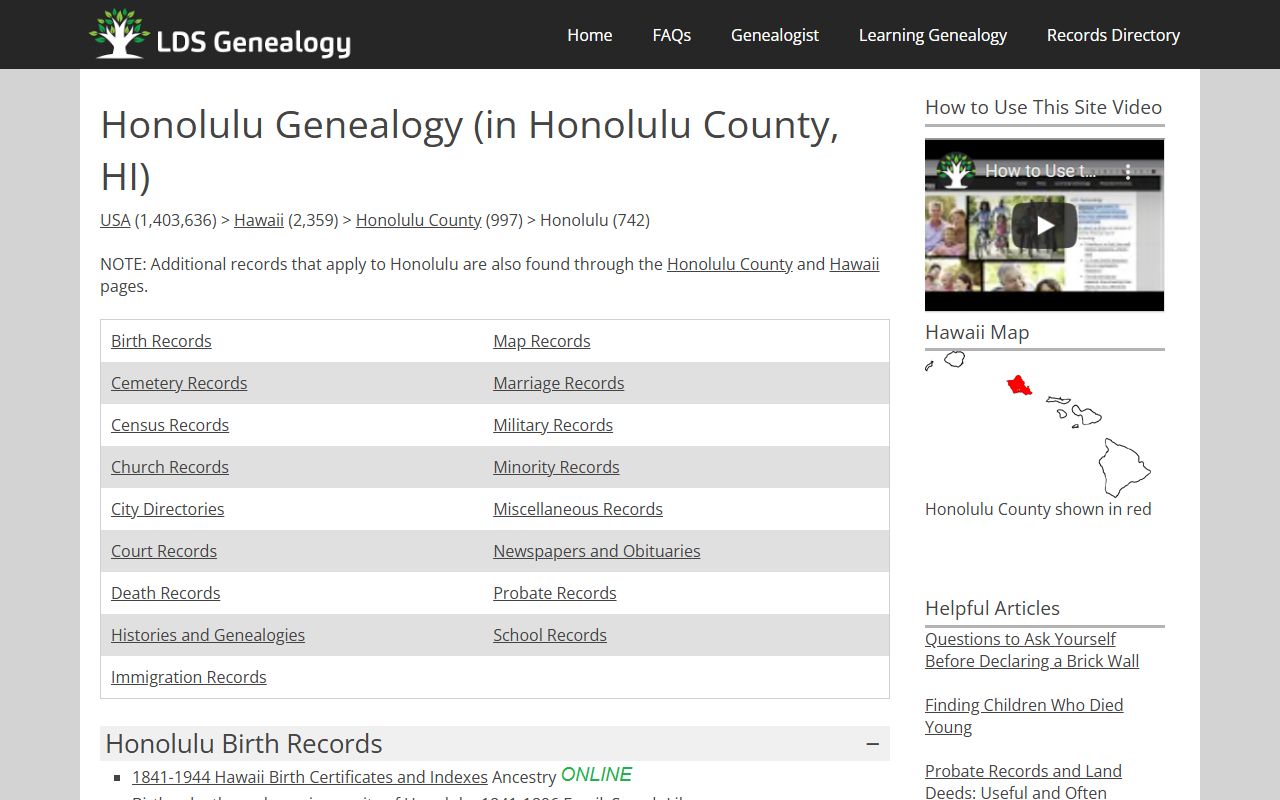
The Archives maintains separate finding aids for each record group, and many collections have been partially or fully digitized for remote access.
Honolulu Libraries and Research Centers
The Hawaii State Library at 478 South King Street in Honolulu provides free in-library access to Ancestry.com at any of its public computers. Call (808) 586-3535 for hours and availability. This is one of the easiest ways to access genealogy databases at no cost. The library also carries local history collections, Hawaiian language materials, and newspaper archives that can supplement official record research.
FamilySearch Centers operate across Honolulu County and offer free access to the FamilySearch digital library, which includes billions of records from Hawaii and around the world. Centers are located in Honolulu at (808) 955-8910, Kalihi at (808) 845-9701, Kaneohe at (808) 247-3134, Laie at (808) 293-2133, Mililani at (808) 623-1712, and Waipahu at (808) 678-0752. Staff volunteers at these centers can help you navigate microfilm collections, use online databases, and interpret older records. No appointment is needed at most locations, though calling ahead is a good idea.
The Bishop Museum in Honolulu holds significant collections related to Hawaiian history and genealogy, including materials on Hawaiian ali'i (chiefly) lineages and historic photographs. For researchers tracing Native Hawaiian or early immigrant ancestry, the Bishop Museum's library and archives are worth contacting directly. The National Memorial Cemetery of the Pacific, known as Punchbowl, maintains burial records for veterans interred there. Find A Grave's Punchbowl listing carries thousands of memorials with dates and service information that can help confirm death dates and family connections.
Punchbowl Cemetery's burial records document veterans interred at the National Memorial Cemetery of the Pacific on Oahu.
The cemetery holds more than 53,000 burials and the Find A Grave database includes many searchable memorials with dates, units, and family notes added by contributors over the years.
For statewide library resources, librarieshawaii.org lists all public library locations, hours, and digital services. Many branches offer access to genealogy databases and local newspaper archives that are not available through standard online subscriptions.
Note: FamilySearch Center hours vary by location, so call ahead before visiting to confirm the center is open and a consultant is available.
Search Honolulu County Records
Sponsored Results
Cities in Honolulu County
Honolulu County covers the entire island of Oahu. The communities below are the largest population centers on the island. Each has its own city page with more specific information on where to find records and which offices serve that area.
Nearby Hawaii Counties
Hawaii has four counties. If your research extends beyond Oahu, the other islands each have their own record-keeping systems. Hawaii County covers the Big Island, Maui County includes Maui, Molokai, and Lanai, Kauai County covers Kauai and Niihau, and Kalawao is the smallest county in the United States, located on the Kalaupapa peninsula of Molokai.
