
Hawaii Genealogy Records
Hawaii genealogy records are held by the State Department of Health, the Hawaii State Archives, county circuit courts, and libraries spread across the islands. You can trace family roots through birth certificates, death records, marriage indexes, probate files, land grants, and census schedules going back to the Kingdom era. The DOH handles certified copies of vital records from July 1909 to the present. The State Archives holds older collections reaching back to the 1850s and beyond. Many records are now searchable online through free databases. This guide covers the key sources, how to request records, and where to start your Hawaii genealogy search.
Hawaii Genealogy Records at a Glance
Hawaii Vital Records for Genealogy
The main place to get certified Hawaii genealogy records is the Department of Health, Office of Health Status Monitoring. This office holds birth, death, marriage, and divorce certificates for events that took place in Hawaii. The office is at 1250 Punchbowl Street, Room 103, in Honolulu. Call (808) 586-4539 or email doh.issuanceQuery@doh.hawaii.gov. Hours are Monday through Friday, 7:45 a.m. to 2:30 p.m. The office is closed on all state holidays. Metered parking is available out front with entry from Punchbowl Street.
A certified copy costs $10 for the first certificate. Additional copies of the same record ordered at the same time are $4 each. Online orders through the eHawaii portal add a $2.50 administration fee, bringing one certified copy to $12.50 total. Mail orders take six to eight weeks and require cashier's checks or money orders payable to the State Department of Health. Personal checks are not accepted for mail requests. In-person payment can be made by cash, credit card, or money order. The online ordering system at vitrec.ehawaii.gov covers birth, marriage, civil union, and death records from July 1909 to the present. You can create a free eHawaii account to track your order status and make re-orders simpler.
Not everyone can get a certified copy of a recent record. For records less than 75 years old, access is limited to the person named on the record, their spouse, parents, children, grandchildren, siblings, grandparents, aunts, uncles, cousins, legal guardians, and others with a court order. Under HRS §338-18, once a record is more than 75 years old it opens to genealogy researchers. Records older than 100 years for births, or 50 years for deaths, marriages, and divorces, become fully public.
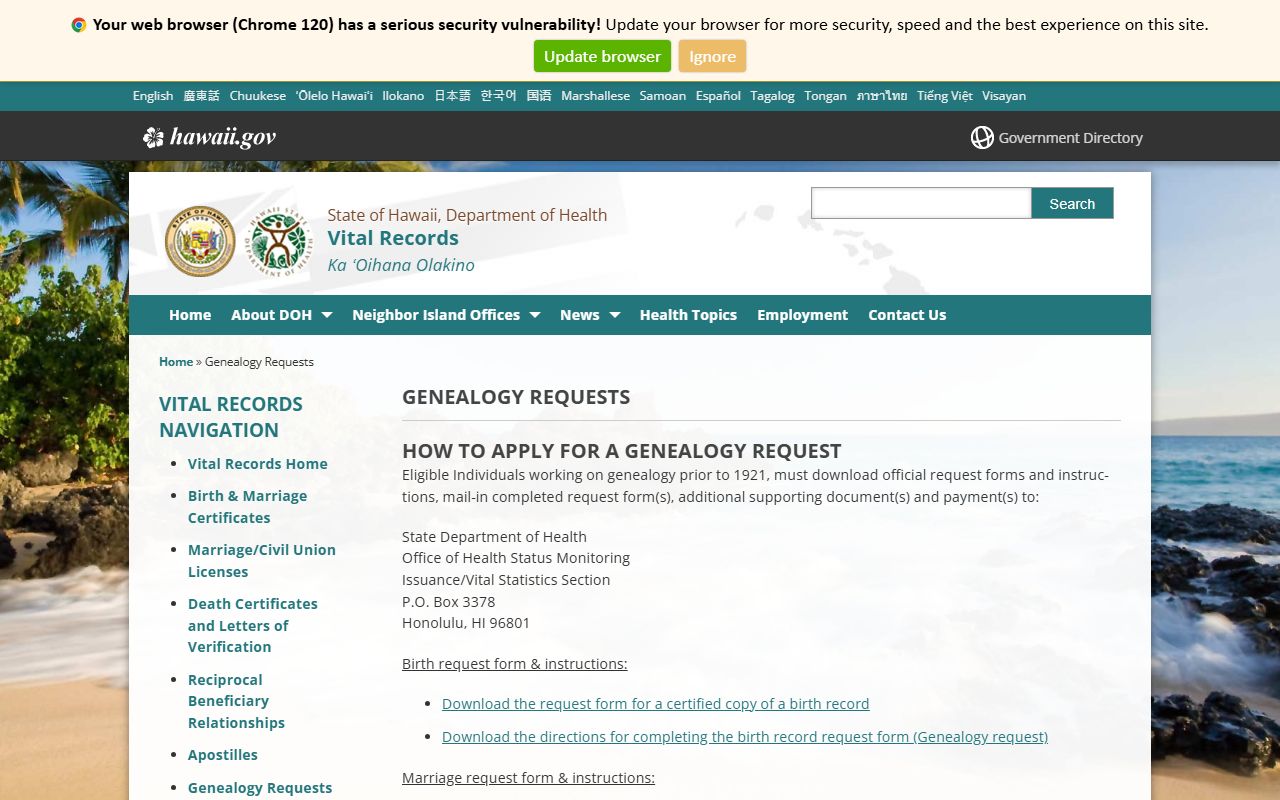
The DOH also maintains a dedicated genealogy requests page that explains the process and provides the correct forms for researchers. Mail requests go to the Office of Health Status Monitoring, Issuance/Vital Statistics Section, P.O. Box 3378, Honolulu, HI 96801. Vital records of events more than 115 years ago require an in-person appointment at the Oahu office.
The DOH vital records homepage is the official starting point for requesting certified Hawaii records.
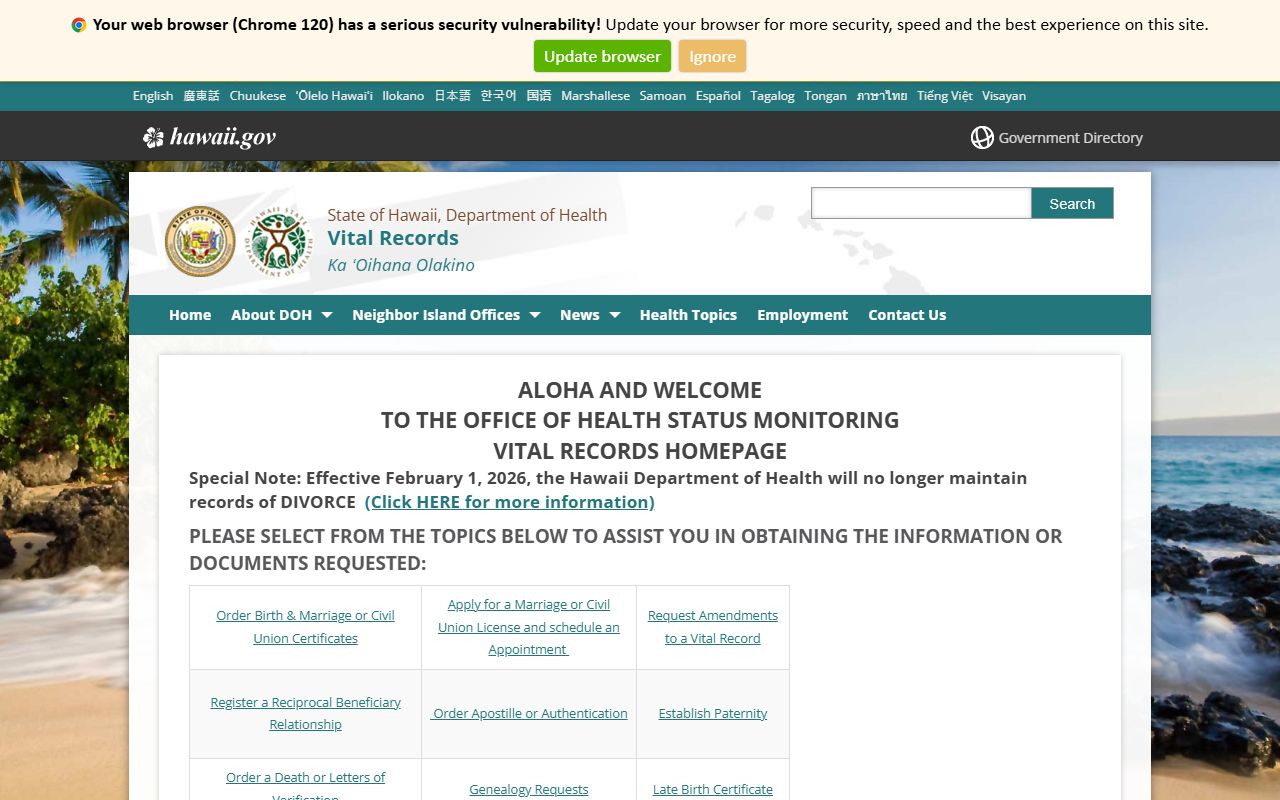
The site shows current fees, processing times, and accepted payment methods for all request types including online, mail, and in-person orders.
The genealogy-specific section of the DOH explains how to request records in the 75 to 115 year range and provides forms for birth, marriage, and death genealogy requests.
Indexes to birth records from 1896 to 1909 are available at Hawaii State Library branches in Hilo, Kahului, Kaneohe, Lihue, and Kailua-Kona, as well as the University of Hawaii Library Hawaiian Collection at (808) 956-8264.
Hawaii State Archives Genealogy Research
The Hawaii State Archives is one of the most important tools for genealogy research in the state. It is located at 'Iolani Palace Grounds, 367 S. King St., Honolulu, HI 96813, and can be reached at (808) 586-0329. The Archives holds an extensive range of records from the Kingdom of Hawaii through the territorial and statehood periods. The genealogy research guide on the Archives site is a detailed breakdown of every collection held and how to access each one.
Birth records at the Archives go back to 1852 on Oahu and 1853 on Hawaii Island. Death records start in 1852 on Oahu. Marriage records cover all islands from 1826 through 1929. These older collections fill the gap before the DOH's 1909 start date, so you often need both agencies to trace a full family line. The Archives also holds divorce case files from 1848 to 1915, naturalization records from 1844 to 1894, denization records from 1846 to 1898, passports from 1845 to 1874, and census records covering Hawaii from 1840 through 1920. Ship passenger manifests with indexes for Chinese, Japanese, Portuguese, and general arrivals round out the immigration-related holdings.
Fifty-three volumes of Hawaiian genealogy books cover royal family lines and traditional oral genealogies predating western contact in 1778. Family names in this collection include Kamehameha, Kalakaua, Kapiolani, Pauahi, Kuhio, and others. These are not available anywhere else. The Archives is the only place to access many of these records in their original or microfilmed form.
The genealogy guide on the State Archives site outlines each collection and explains the access process.
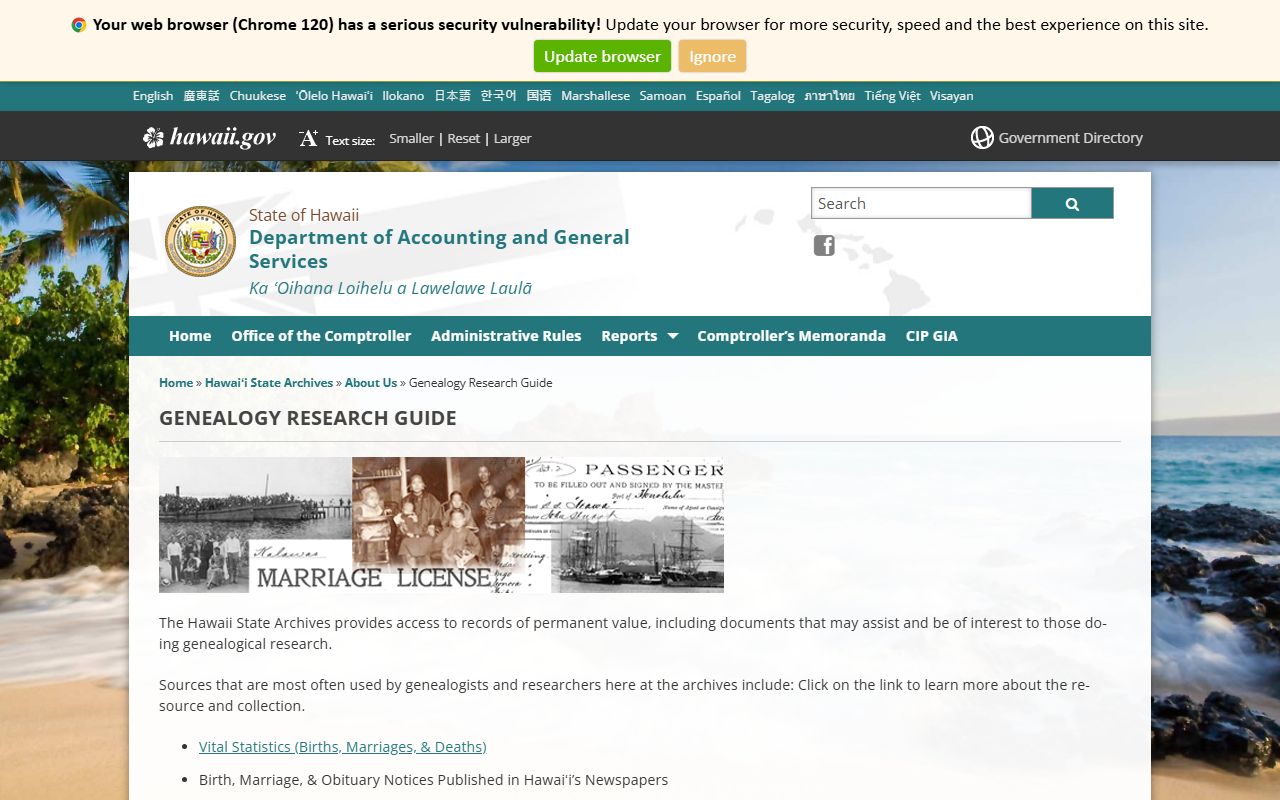
The guide breaks collections down by record type and gives specific date ranges and access instructions for each one.
The Hawaii State Archives Digital Collections site puts many of these records online at no cost. The digital repository holds vital statistics, marriage record indexes, digitized microfilms, probate case files, land records, and passenger manifests. Marriage record indexes are searchable by name. Results include a reference number where the letter represents the island, the next number is the volume, and the following number is the page. Use that reference to find the actual microfilmed document. Early records may be incomplete because vital statistics were under-reported in the first years of required registration.
No account is needed to search the digital archive's online indexes, making it one of the most accessible starting points for Hawaii genealogy research.
Hawaii Genealogy Online Search Tools
The Ulukau Hawaiian Electronic Library holds genealogical indexes covering marriages from 1826 to 1929, divorce case files from 1848 to 1915, probates from 1847 to 1917, wills from 1852 to 1916, naturalizations from 1844 to 1894, and passports from 1845 to 1874. Search by name and results show volume and page references. Many records are in Hawaiian. Knowing a few key terms helps: inoa means name, hanau means birth, make means death, kane means male, and wahine means female. Records from 1896 onward may include parents' names, race, age, and place of residence. Ulukau links to digital copies when available, making it a strong starting point for pre-statehood research.

The library site is free to access and covers records from individual ministers, marriage agents, and school teachers who were required by law to report vital events.
FamilySearch has a large free collection for Hawaii at familysearch.org. Available records include Hawaii Births and Christenings 1852 to 1933, Hawaii Marriages 1826 to 1954, Hawaii Deaths and Burials 1862 to 1919, Hawaii Wills and Probate Records 1822 to 1962, Hawaii Tax Assessment Rolls 1847 to 1903, and Hawaii Naturalization Records 1838 to 1991. FamilySearch also operates Family History Centers on Oahu, Maui, and Hawaii Island where staff can help with in-person research. On Oahu centers are in Honolulu, Kalihi, Kaneohe, Laie, Mililani, and Waipahu.
Ancestry.com has a dedicated Hawaii section at ancestry.com with birth certificates, marriage indexes, death records, and census data. A subscription is needed outside the library. The Hawaii State Library's main Honolulu branch offers free Ancestry.com access inside the building.
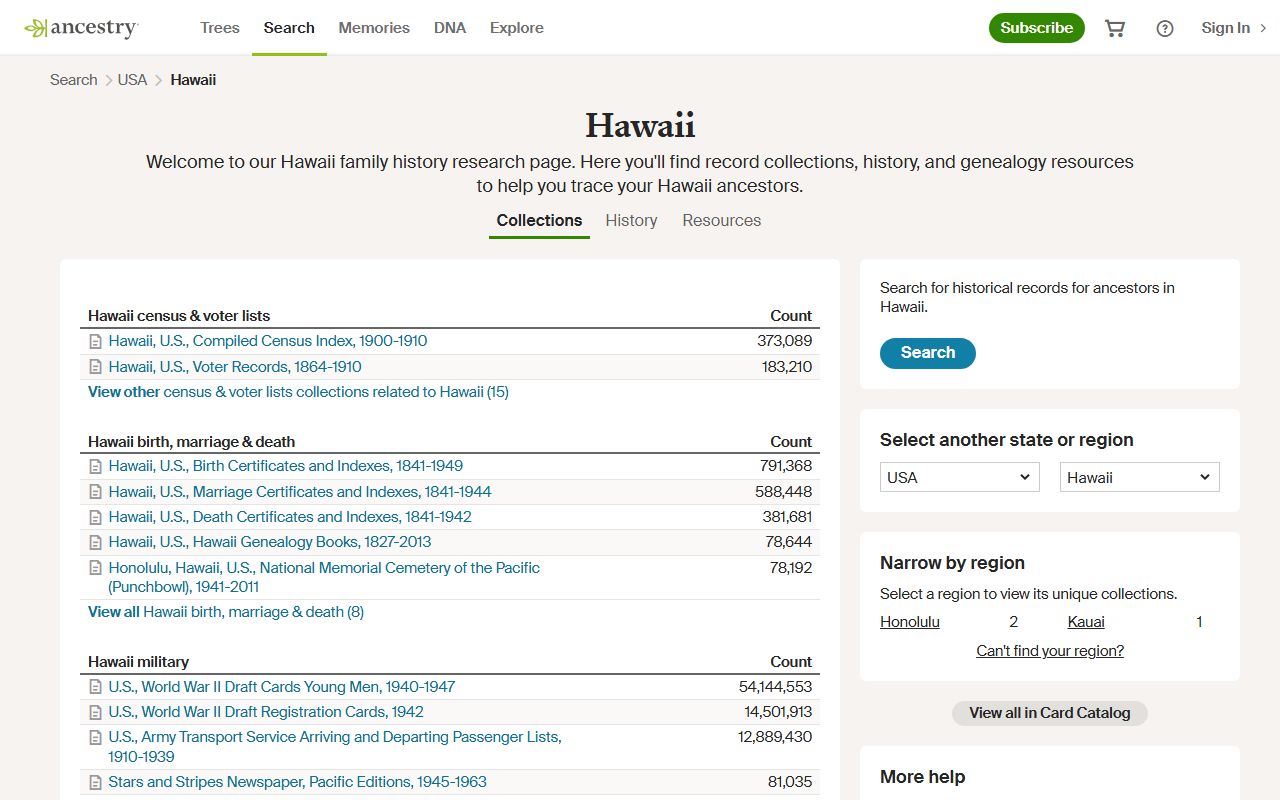
Ancestry's Hawaii collection overlaps with FamilySearch but also includes records and indexes not available on the free platform.
Access Genealogy Hawaii provides a free directory of resources organized by record type, including death records, land records, and census transcriptions. The site links to both free and subscription databases without requiring an account.
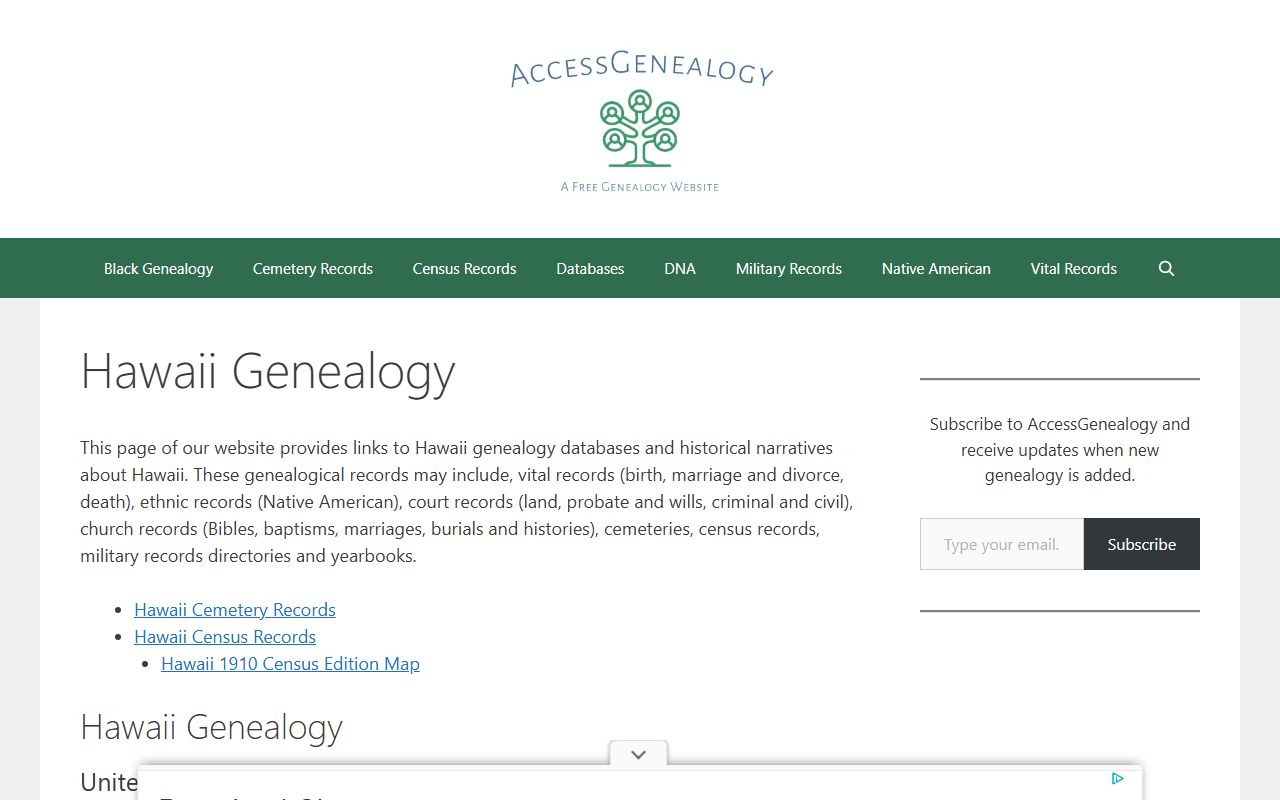
Access Genealogy is useful for finding collections that don't come up in a standard search engine query.
The Hawaii Genealogy website organizes local resources by county and links to archives, libraries, and databases across all five islands.
The site is a practical reference for county-level contacts and record collections when working on island-specific family history research.
Land Records and Hawaii Family History
The Bureau of Conveyances maintains Hawaii land records going back to 1845. It is part of the Department of Land and Natural Resources and is at 1151 Punchbowl St #120, Honolulu. Call (808) 587-0147 (general) or (808) 586-0380 (direct). Grantor and Grantee Indexes list the book (Liber) and page of each recorded transaction dating to 1845. Many early entries are in Hawaiian. These indexes are important for tracing family names through property transfers, adoption deeds, kuleana land grants, and inheritance. They also help connect different spellings of the same name.
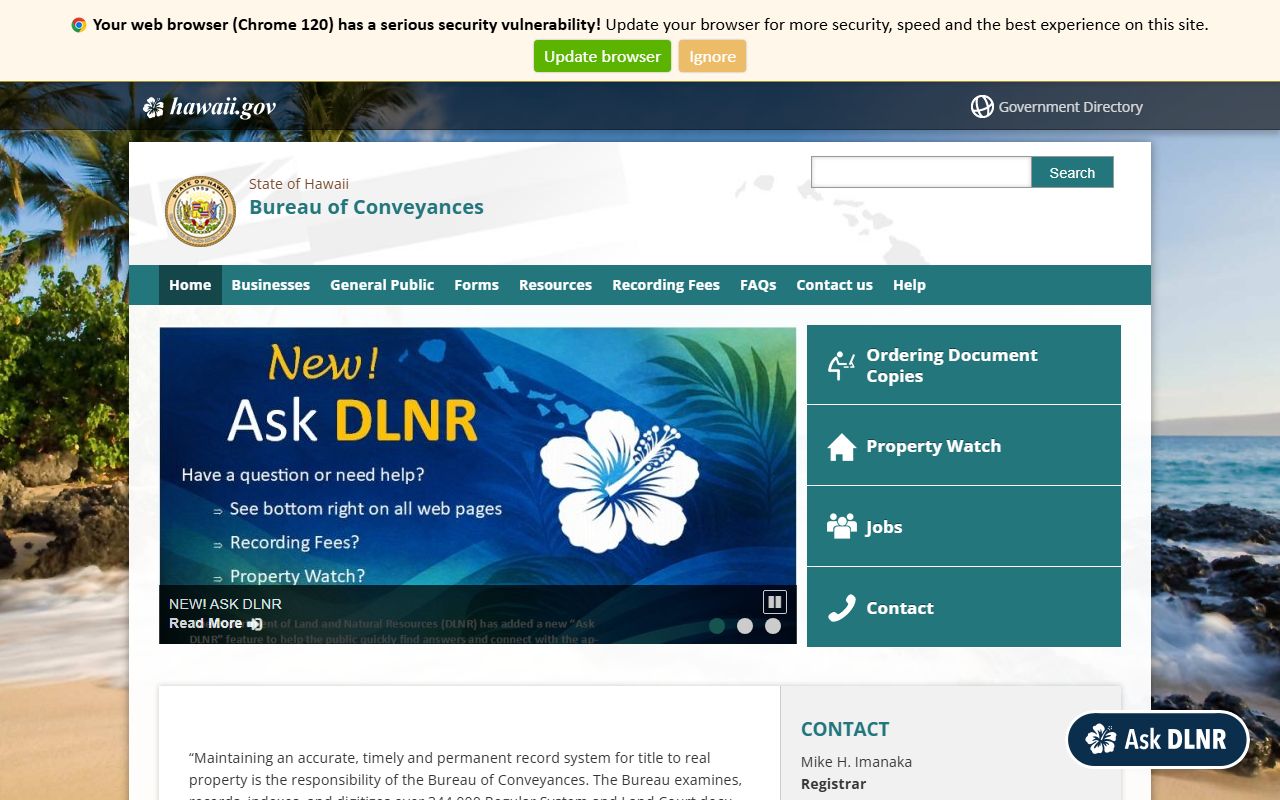
The Bureau processes over 344,000 Regular System and Land Court documents each year and certifies copies of all recorded matters.
The Land Court system was set up in 1903 through Act 56 by the Hawaii Territorial Legislature. It issues Certificates of Title that guarantee the accuracy of a registered land title. Based on the Torrens system, each certificate names the person the land is registered to, describes the parcel, and summarizes any encumbrances. A FamilySearch index covers Hawaii Grantor and Grantee records for free from 1845 to 1909. The Public Reference Room at the Bureau, Room 123, allows access to Grant Books and indexes with staff assistance available during business hours.
The broader Department of Land and Natural Resources oversees related historical databases. The University of Hawaii at Manoa's Hamilton Library holds DLNR Native and Foreign Register and Testimony materials from the Mahele land grants on microfilm. The Mahele records from the 1840s are critical for Native Hawaiian land ownership research. The DLNR General Index of Land Commission Patents is also available at the Hawaii State Library main branch.
Land records can confirm residence, family relationships, and name variations in ways that vital records sometimes do not.
Ethnic and Cultural Genealogy Archives in Hawaii
Hawaii's genealogy landscape reflects the diverse communities that arrived starting in the 1800s. Several cultural institutions hold records specific to the ethnic groups who settled the islands as missionaries, merchants, contract laborers, and immigrants.
The Bishop Museum Archives and Library holds genealogy manuscripts covering Hawaiian royalty, personal letters, journals, photographs, oral histories, and Hawaiian-language materials. All collections are indexed by name. The Museum is at 1525 Bernice St., Honolulu. Archives line: (808) 848-4182. Library line: (808) 848-4148. Email: archives@bishopmuseum.org. Open Tuesday through Saturday. There is a fee for copies. Call for current rates. Founded in 1889, the Museum documents cultural and natural history across the Pacific Basin and holds the most complete records of Hawaiian ali'i genealogy available to the public.

The Bishop Museum's Hawaiian Royal family collections and genealogy manuscripts are not duplicated elsewhere and are essential for ali'i ancestry research.
The Japanese Cultural Center of Hawaii is a resource for Japanese-American family history on the islands. Japanese immigrants arrived as plantation laborers beginning in the 1880s and became the largest ethnic group in Hawaii by the early 1900s. Plantation labor records for Japanese workers are at the Hamilton Library, University of Hawaii at Manoa, as part of the Hawaiian Sugar Planters' Association archives. These records include worker arrival data, family information, and labor contracts from multiple plantation companies.
The JCCH holds exhibits and reference materials related to Japanese-American history in Hawaii, including the World War II internment period and postwar community records.
The Okinawan Genealogical Society of Hawaii, operating under the Hawaii United Okinawa Association, holds materials specific to Okinawan-Hawaiian families. Okinawan immigrants began arriving in 1900. Their descendants are a prominent part of Hawaii's population. The HUOA maintains genealogy resources, family registries, and connections to records in Okinawa Prefecture in Japan. Researchers can get help tracing lineages across the Pacific through this organization.
The HUOA can connect researchers with contacts in Japan and help navigate records held by Okinawan municipal offices.
The Center for Korean Studies at the University of Hawaii supports research into Korean-Hawaiian family history. Korean immigrants arrived starting in 1903. They came as plantation workers. Korean immigration records from the early 1900s are available through the Hawaii State Archives and FamilySearch. The Center links researchers to sources in both Hawaii and Korea, including early passenger lists and naturalization files.
Korean passenger manifests and early naturalization records are useful starting points for Korean-Hawaiian genealogy searches.
The Hawaiian Historical Society holds a library and archives focused on Hawaiian history from the Kingdom period forward. Collections include periodicals, maps, photographs, and rare books covering Hawaiian families and key historical events. The Society covers both native Hawaiian families and the wider community of settlers, missionaries, and immigrants who shaped the islands' history from first contact through the twentieth century.
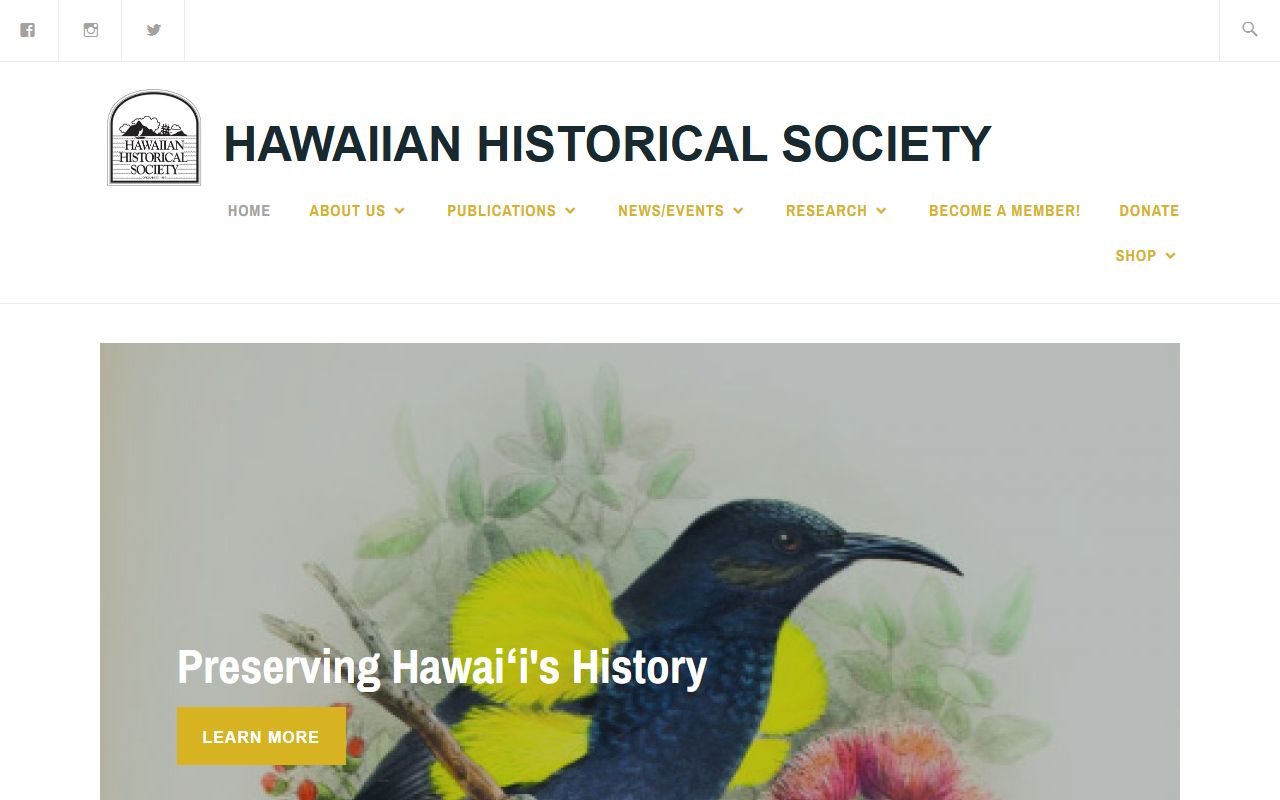
The Hawaiian Historical Society is useful for researchers tracing mixed ancestry or looking into the broader social context of their family's life in Hawaii.
Libraries and Hawaii Genealogy Research Centers
The Hawaii State Library main branch at 478 South King Street in Honolulu is the leading public genealogy research center in the state. Call (808) 586-3535 to reach the Hawaii and Pacific Collection. The library holds microfilm for birth, marriage, and death indexes, census records from 1900 through 1930, ship passenger manifests from 1843 to 1900, and Honolulu city directories from 1884 through 1960. Free Ancestry.com access is available inside the library. A library card is required for database access. The library also holds Sanborn Fire Insurance Maps and the DLNR General Index of Land Commission Patents on microfilm, both useful for property and neighborhood research.
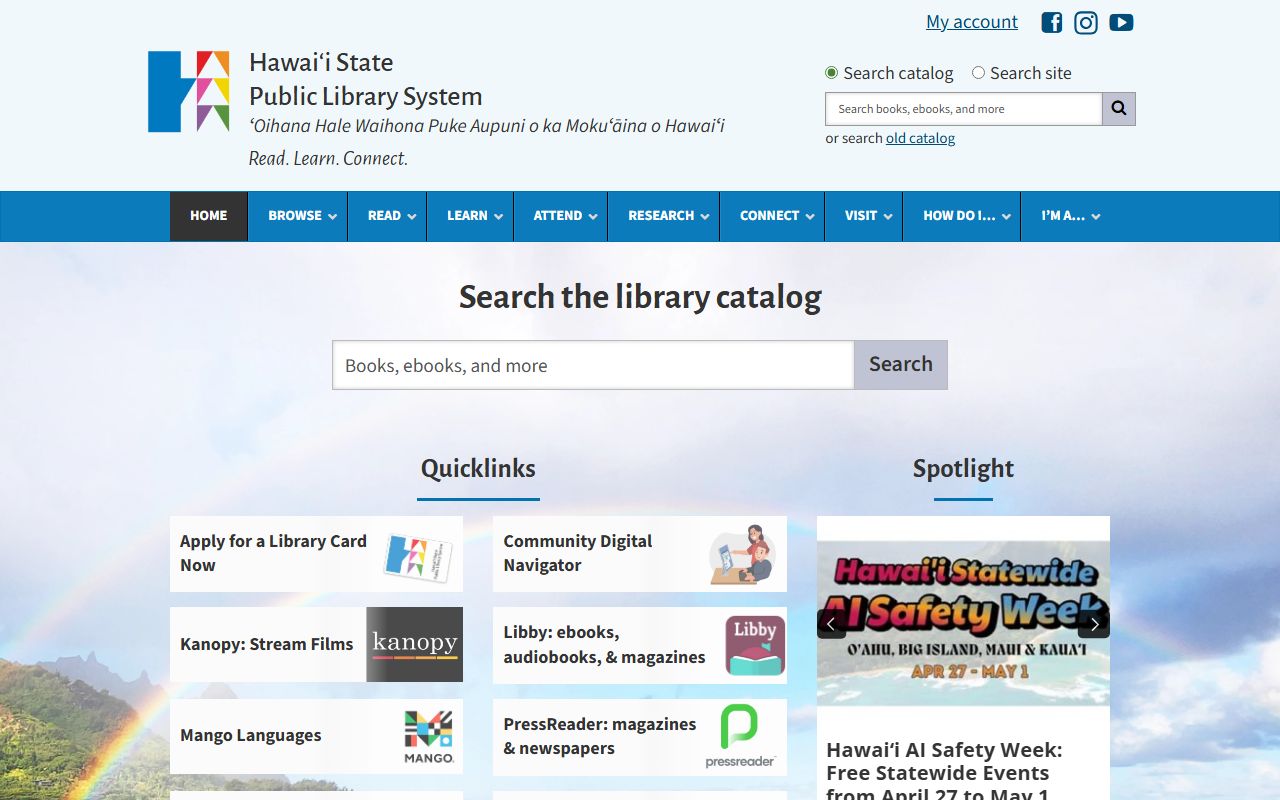
Branch libraries on Oahu, Maui, Kauai, and Hawaii Island also hold genealogy microfilm and birth indexes from 1896 to 1909.
The library system maintains a Hawaii Newspaper Guide that lists every available paper title, the years it was in print, microfilm availability, and index access. Available papers include the Honolulu Star-Advertiser, Honolulu Advertiser, Honolulu Star Bulletin, Maui News, Hawaii Tribune Herald, West Hawaii Today, and Garden Island on Kauai. Newspaper indexes to birth, marriage, and death notices cover 1850 to 1950. An obituary index for the Honolulu papers runs from 1929 to 1969. A keyword-searchable newspaper index is available online for 1989 to the present.
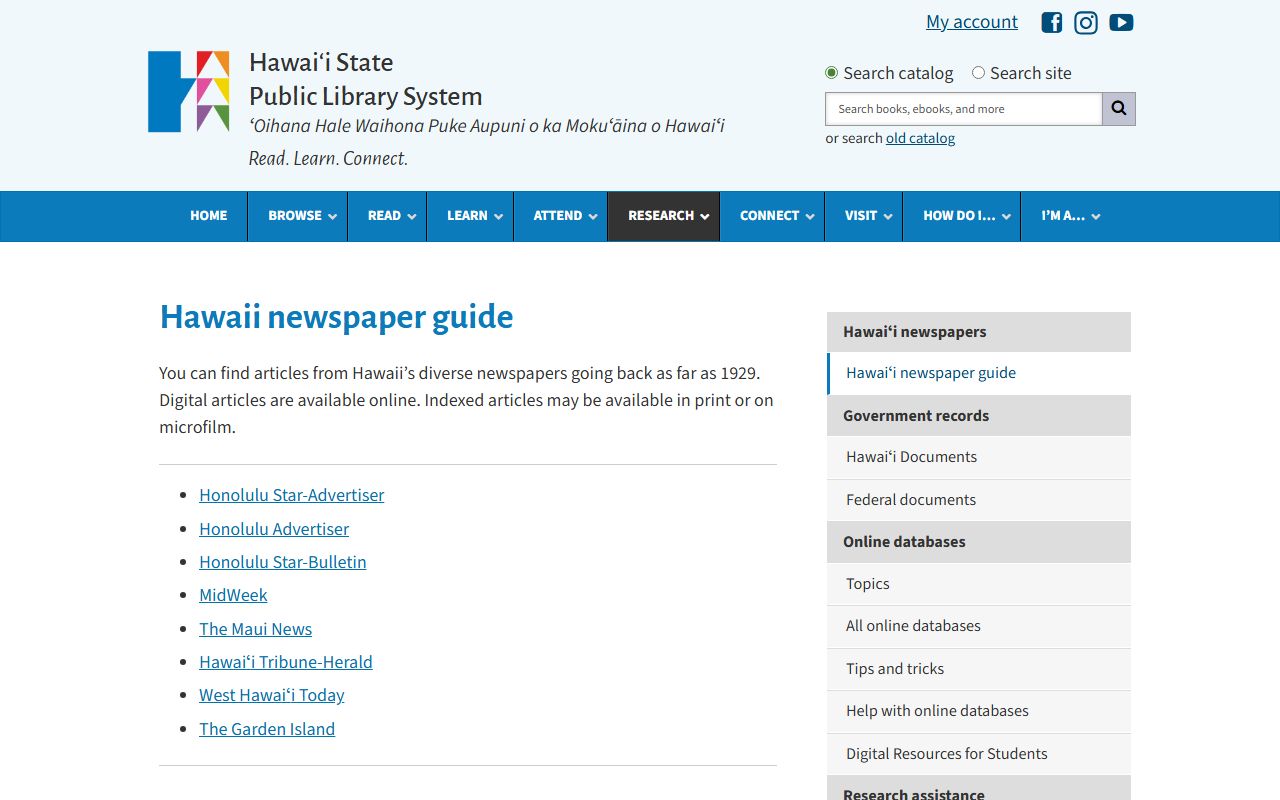
Newspaper notices are a practical way to find ancestors who may not appear in official vital records, especially for births and deaths in rural areas before consistent registration began.
The University of Hawaii at Manoa has a comprehensive genealogy research guide maintained by its library staff. It covers vital records, land records, newspapers, and databases. The Hawaiian Collection at Hamilton Library is at (808) 956-8264. The guide covers the Papakilo Database, Chronicling America Hawaii newspapers in English from 1836 to 1922, and the Honolulu Star-Advertiser collection going back to 1836. The guide links to both free and subscription resources.
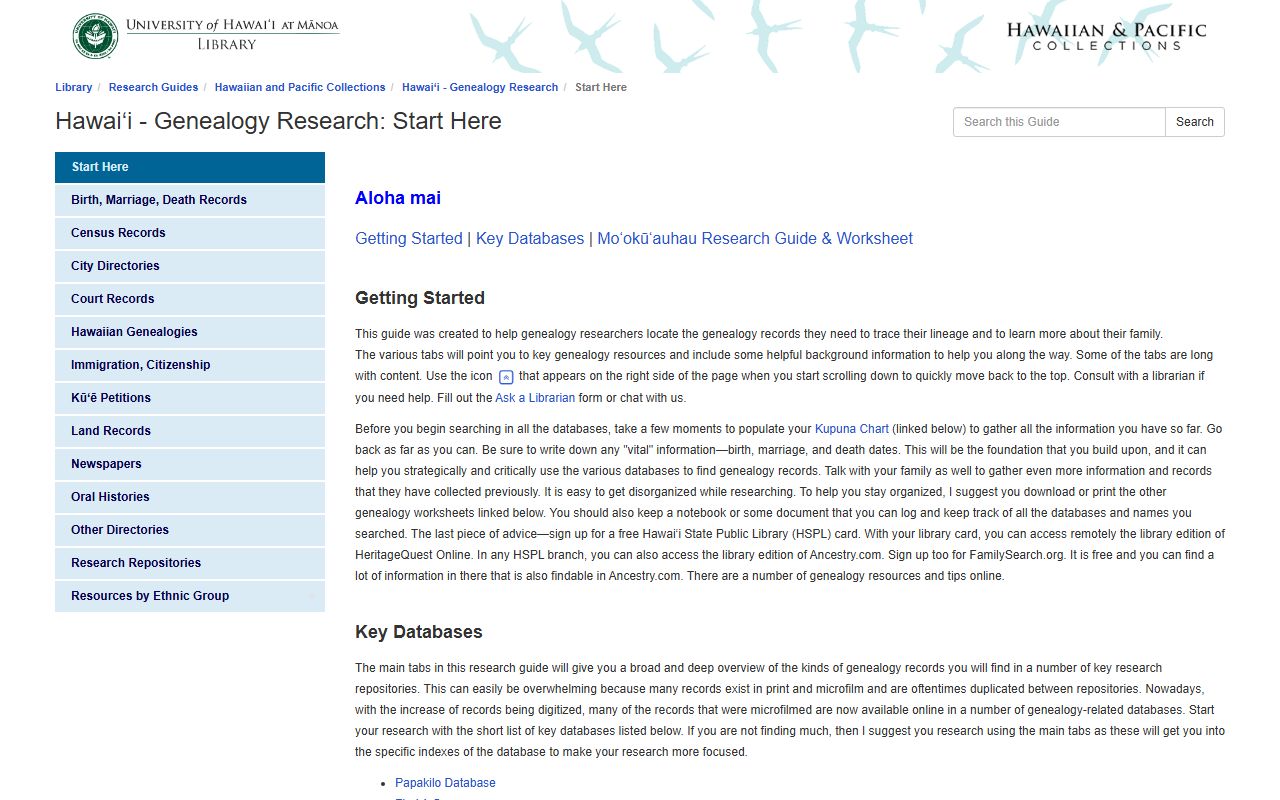
The UH guide is free to access online and is updated by librarians, making it a reliable index of current Hawaii genealogy databases.
Death Records and Newspapers for Hawaii Genealogy
Newspapers hold a wealth of genealogy data for Hawaii. The State Archives holds indexes covering birth notices from 1850 to 1950, marriage notices from 1850 to 1950, and obituary notices from 1836 to 1950. Papers indexed include the Pacific Commercial Advertiser, Honolulu Advertiser, Friend, Hawaiian Gazette, Independent, Ka Hae Hawaii, Polynesian, and Honolulu Star-Bulletin. For English-language papers from 1836 to 1922, the Library of Congress Chronicling America collection provides free full-text search. Hawaiian-language papers from 1834 to 1948 are searchable through the Papakilo Database and Ulukau.
Death and burial records are aggregated across several databases. The Hawaii Death and Burial Indexes page provides links to FamilySearch death collections, cemetery databases, and state vital statistics.
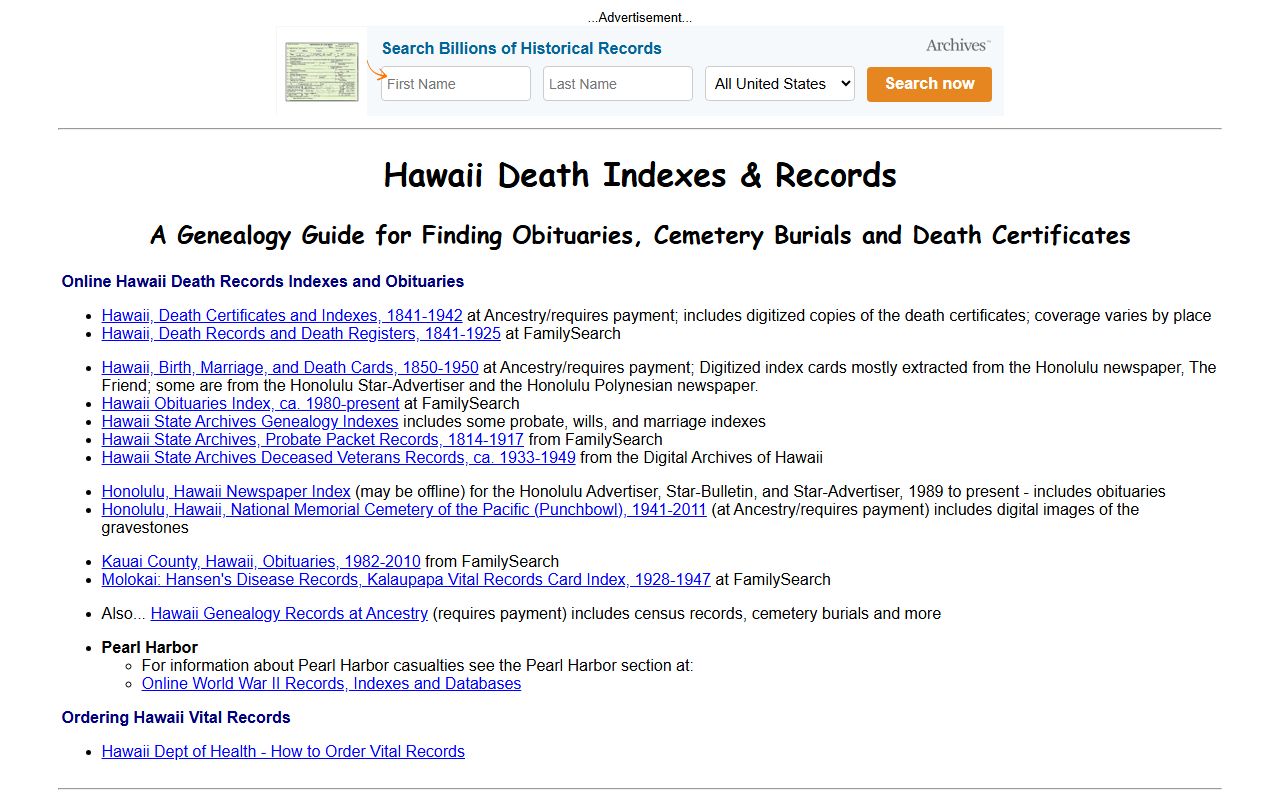
The page points to specific collections including Hawaii Deaths and Burials 1862 to 1919 on FamilySearch and Hawaii Death Certificates and Indexes 1841 to 1942 on Ancestry.
Note: Obituary notices in Hawaiian-language papers were often the first official record of a death for Native Hawaiian families in the 1800s, making them an important backup when vital records are incomplete.
Genealogy Offices on Neighbor Islands
Each major island has a District Health Office that supports vital records requests and genealogy guidance locally. On Hawaii Island, the Hawaii Island District Health Office has two locations. The Hilo office is at 75 Aupuni Street, Suite 201, (808) 974-6008. The Kamuela office is at 67-5189 Kamamalu Street, (808) 887-8114. Both are open Monday through Friday, 7:45 a.m. to 4:30 p.m. Birth indexes from 1896 to 1909 are available at the Hilo Public Library. Hawaii Island is served by the Third Circuit Court in Hilo and the Fourth Circuit Court for West Hawaii, both of which hold historical court records useful for genealogy.
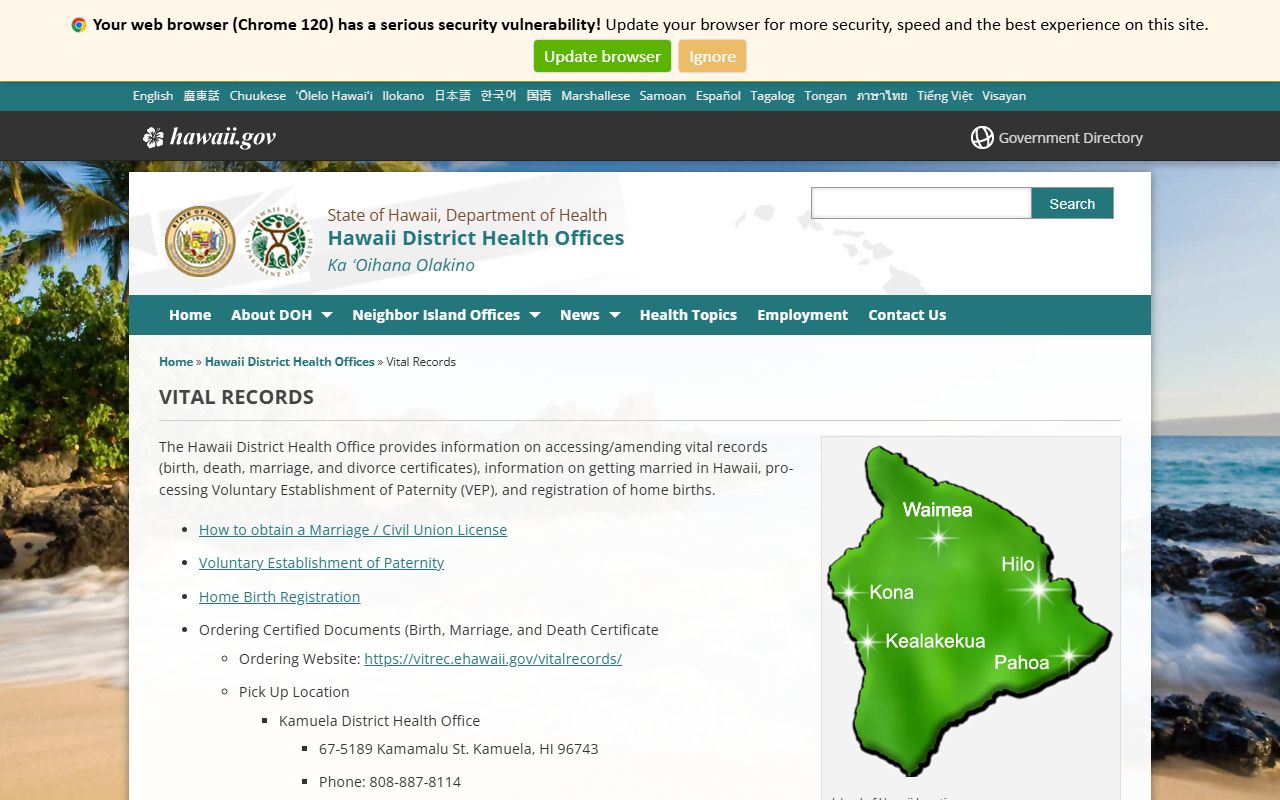
The Hilo office provides guidance for Big Island birth and death record requests and directs researchers to the correct archives for older materials.
Kalawao County on the Molokai peninsula has a unique genealogy history tied to the Kalaupapa leprosy settlement that operated from 1866 onward. Over 8,000 people with Hansen's disease were sent there. Records about residents are held at the Hawaii State Archives and include the Kalaupapa Death Register of Patients, Kalaupapa Marriage Documents, the Kalaupapa Patient Register, and the Hansen's Disease Records Kalaupapa Census Index covering 1839 to 1970. The Department of Health Kalaupapa Settlement office at PO Box 4444, Kalaupapa, HI 96742 holds remaining settlement records. Access to some of these materials may be restricted due to the sensitive nature of Hansen's disease history.
Researchers with Kalaupapa ancestry should also contact the National Park Service, which manages Kalaupapa National Historical Park and can help direct inquiries to the right sources.
Public Records Access and Hawaii Genealogy Law
Hawaii's Uniform Information Practices Act (UIPA) requires state agencies to disclose government records unless access is closed by law. For genealogy, the key statute is HRS §338-18, which governs vital statistics access. Records become fully public when 100 years have elapsed since a birth date, or 50 years after a death, marriage, or divorce. Records older than 75 years are accessible for genealogy research under Section 338-18(e). For records in the 75 to 115 year range, requesters may still need to show some connection to the record at issue. Appointments with DOH staff are available for events older than 115 years.
Index data including name, age, sex, date, type, and file number may be made available to the public even for recent records. Full certified copies of recent records require direct and tangible interest in the document. Anyone researching events beyond the 75-year window can access records at the DOH Oahu office by appointment or through the State Archives digital collections online at no charge.
The City and County of Honolulu maintains its own municipal records at the Municipal Reference and Records Center, City Hall Annex, (808) 523-4044. City legislative records go back to 1905. The collection includes financial documents, public works photos, and 19th-century engineering maps. Access is available Monday through Friday, 9 a.m. to 3 p.m. Archives visits require an appointment.
City and County records are separate from state holdings and can fill gaps for Oahu-based research that state agencies don't cover.
Browse Hawaii Genealogy by County
Hawaii has five counties, each with its own circuit court and local genealogy resources. Select a county below to find office details, courthouse information, and county-specific record collections.
Hawaii Genealogy Records by City
Major communities across all islands are covered by county genealogy offices. Select a city to find local office contacts, library resources, and guidance specific to that area.