
East Honolulu Genealogy Records
East Honolulu genealogy research draws on a rich set of records held across state and county agencies in Honolulu County. Vital records, court files, land documents, and probate records go back as far as the mid-1800s, making this area a strong starting point for family history work. The First Circuit Court, the Hawaii State Archives, the State Department of Health, and several local libraries all play a role in keeping these records available to researchers.
East Honolulu Quick Facts
Vital Records for East Honolulu
Birth, death, and marriage certificates for East Honolulu residents are filed with the Hawaii State Department of Health, Office of Health Status Monitoring. The office is at 1250 Punchbowl Street, Room 103, Honolulu, and can be reached at (808) 586-4539. Hours are Monday through Friday, 7:45 a.m. to 2:30 p.m. The first certified copy of any vital record costs $10. Each extra copy ordered at the same time is $4. If you order online through the state portal, a $2.50 service fee applies.
Under Hawaii Revised Statutes Section 338-18, records that are 75 years old or older are open to the general public for genealogy use. More recent records are restricted. You must show a direct and tangible interest to get a copy of a recent record. Close relatives, legal representatives, and researchers with a court order can qualify. If you are not sure whether you qualify, call the office before you drive over or send a request by mail.
Online orders go through eHawaii Vital Records. The site lets you order birth, death, and marriage certificates without coming in person. Processing times vary, so plan ahead if you need a record for a legal matter or a pending application.
Hawaii State Archives Access
The Hawaii State Archives at 367 South King Street in Honolulu is the main hub for older genealogy records in the state. For East Honolulu research, the Archives holds Oahu birth records from 1852 to 1885, death records from 1852 to 1873, and marriage records from 1826 to 1929. These pre-statehood and territorial-era records are not available through the Department of Health. The Archives phone number is (808) 586-0329.
Divorce case files from the First Circuit covering 1848 to 1915 are also at the Archives. Naturalization records run from 1838 to 1991. These can be useful when tracing immigrant ancestors who passed through Honolulu on their way to or from the plantation districts. Researchers can also find passenger lists, land commission records, and some early census materials in the collection.
The Archives has a growing set of digital collections through Hawaii Digital Archives. Some record sets can be browsed online at no cost. Not everything is digitized yet, but the coverage keeps expanding. It is worth checking the digital portal before you plan a visit, since you may find what you need without leaving home.
The probate records guide available at the Archives covers First Circuit probate filings from 1847 to 1921 and wills from 1893 to 1916. These files often name heirs, list property, and give family relationships in detail. They are among the most useful records for reconstructing family structures from the late 1800s and early 1900s.
The Hawaii State Archives probate and wills research guide explains how to find and use these older records for East Honolulu family history projects.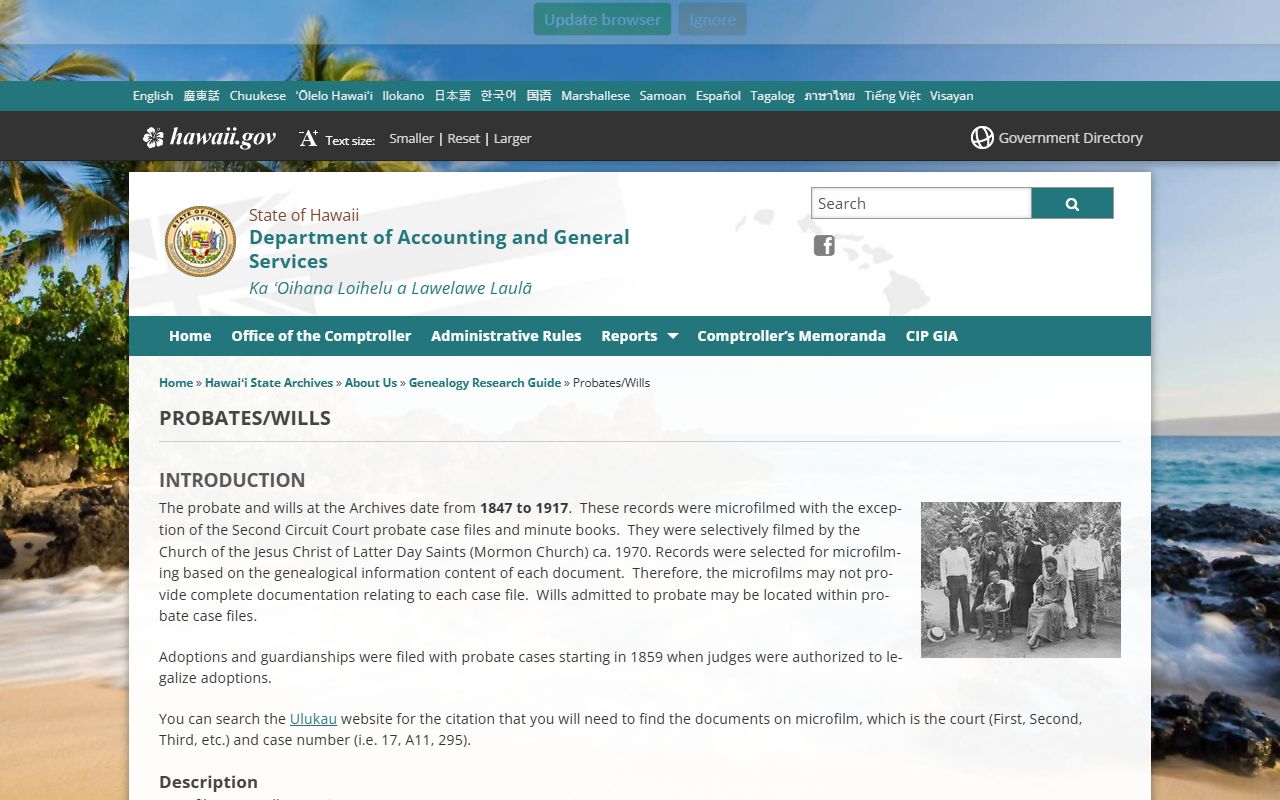
Probate files from the First Circuit often list full names of heirs and surviving relatives, which makes them a strong resource when vital records are missing or incomplete for an East Honolulu family line.
First Circuit Court Records
The First Circuit Court handles civil, family, and probate matters for all of Honolulu County, including East Honolulu. You can search case records through eCourt Kokua, the Hawaii state court search portal. The system lets you look up cases by party name or case number. Regular copy fees are $3 per page. Certified copies cost $5 per page.
For older court files not yet online, you may need to contact the circuit court clerk directly or visit the Hawaii State Archives, which holds many pre-1920 court records. Divorce filings from 1848 to 1915 and naturalization records from 1838 to 1991 are both at the Archives rather than the courthouse. Note: Some old case files have been transferred to off-site storage, so call ahead to confirm availability before visiting.
Library Resources for Research
The Hawaii State Library at 478 South King Street in Honolulu is a top resource for East Honolulu genealogy work. The phone number is (808) 586-3535. The library holds microfilm copies of birth records from 1909 to 1948, death records from 1909 to 1949, and marriage records from 1909 to 1949. These microfilm rolls are available for in-person viewing. Library cardholders can also access Ancestry.com for free while inside the building.
Newspaper indexes at the State Library cover 1929 to 1969 and 1989 to the present. Old newspaper notices for marriages, deaths, and legal matters can fill gaps when official records are missing. Obituaries, in particular, often name surviving family members and give details that vital records do not.
East Honolulu residents are close to Hawaii Kai Public Library, which serves the community directly. Kailua Public Library and the main Honolulu library branch are also within a reasonable drive. Birth indexes covering 1896 to 1909 are available at Kaneohe Public Library, which is especially useful for researchers working on families from that era.
FamilySearch Centers on Oahu
Two FamilySearch Centers serve Oahu researchers. The Kaneohe center can be reached at (808) 247-3134 and the Honolulu center at (808) 955-8910. Both offer access to microfilm, digital records, and research guidance at no cost. FamilySearch has digitized a large set of Hawaii records covering 1826 to 1954, which are searchable through the FamilySearch website. The online collection includes vital records, probate files, land records, and more. This is a good first stop before requesting physical copies from agencies.
Land and Property Records
The Bureau of Conveyances at 1151 Punchbowl Street, Suite 120, Honolulu keeps land transfer records for all of Hawaii. The phone number is (808) 587-0147. Grantor and grantee indexes go back to 1845. These records show who owned land, when it changed hands, and who was involved in each transaction. Property records are often the only way to place an ancestor at a specific address in a given year, especially before formal census records or city directories were kept for the area.
For East Honolulu researchers, land records can help trace families who moved between town and the eastern districts over time. Some early deeds also name family relationships, such as when land was transferred from a parent to a child or between siblings.
Ulukau and Hawaiian-Language Sources
The Ulukau Hawaiian Electronic Library holds digitized Hawaiian-language newspapers and historical records, including marriage records from 1826 to 1929 and probate records from 1847 to 1917. Many of these records are in Hawaiian. If your ancestors were Native Hawaiian or lived in Hawaii before the 20th century, Ulukau can provide information not found in English-language archives. The site is free to use and accessible online at any time.
Funeral Homes and Death Records
Funeral homes in the Honolulu area sometimes hold older records that are not held anywhere else. Diamond Head Mortuary and Borthwick Mortuary, both in Honolulu, have served the East Honolulu area for many years. If you are trying to confirm a death date or find next-of-kin information for a recent ancestor and the official record is restricted, contacting the funeral home that handled the burial may help. Some homes keep records going back several decades.
The Hawaii State Archives genealogy research guide is a key starting point for East Honolulu family history work, covering all major record types held in the state collection.
Using the Archives guide helps researchers understand what East Honolulu records exist, where they are held, and how to request access to them, which can save significant time during a family history search.
Tips for East Honolulu Research
Start with what you know and work backward. Gather names, dates, and places from family members before you search official sources. Even rough dates help you narrow down which record sets to check first.
Here are some practical steps for East Honolulu genealogy research:
- Check the Hawaii State Archives digital portal before visiting in person -- some records are already online
- Use the State Library's free in-library Ancestry.com access for census and vital record indexes
- Contact the nearest FamilySearch Center for guidance on Hawaii-specific record sets
- Request vital records from the Department of Health for records under 75 years old, or search the Archives for older records
- Check the Bureau of Conveyances for land records if your ancestors owned property in the area
Note: Processing times at the Department of Health can run several weeks during busy periods. If you need a record fast, call ahead to ask about current wait times before submitting a mail request.
Nearby Cities
If your research extends beyond East Honolulu, these nearby communities also have genealogy records held through Honolulu County agencies:
- Urban Honolulu -- the seat of Honolulu County, with direct access to the State Archives and circuit court
- Kailua -- a windward Oahu community with its own library resources and records access
- Kaneohe -- home to a FamilySearch Center and a public library holding early birth indexes
All three cities are served by the same First Circuit Court and the same state-level agencies, so records for families who lived across these areas are held in the same repositories.